Field test Reviews 10 min
Riverstone Monticello Review: The USA Aluminum Kit
What Riverstone Monticello (MONT) owners report: US-made aluminum kits from $3,150 to $11,799, the tier breakdown, and how it stacks up against the Exaco Riga.
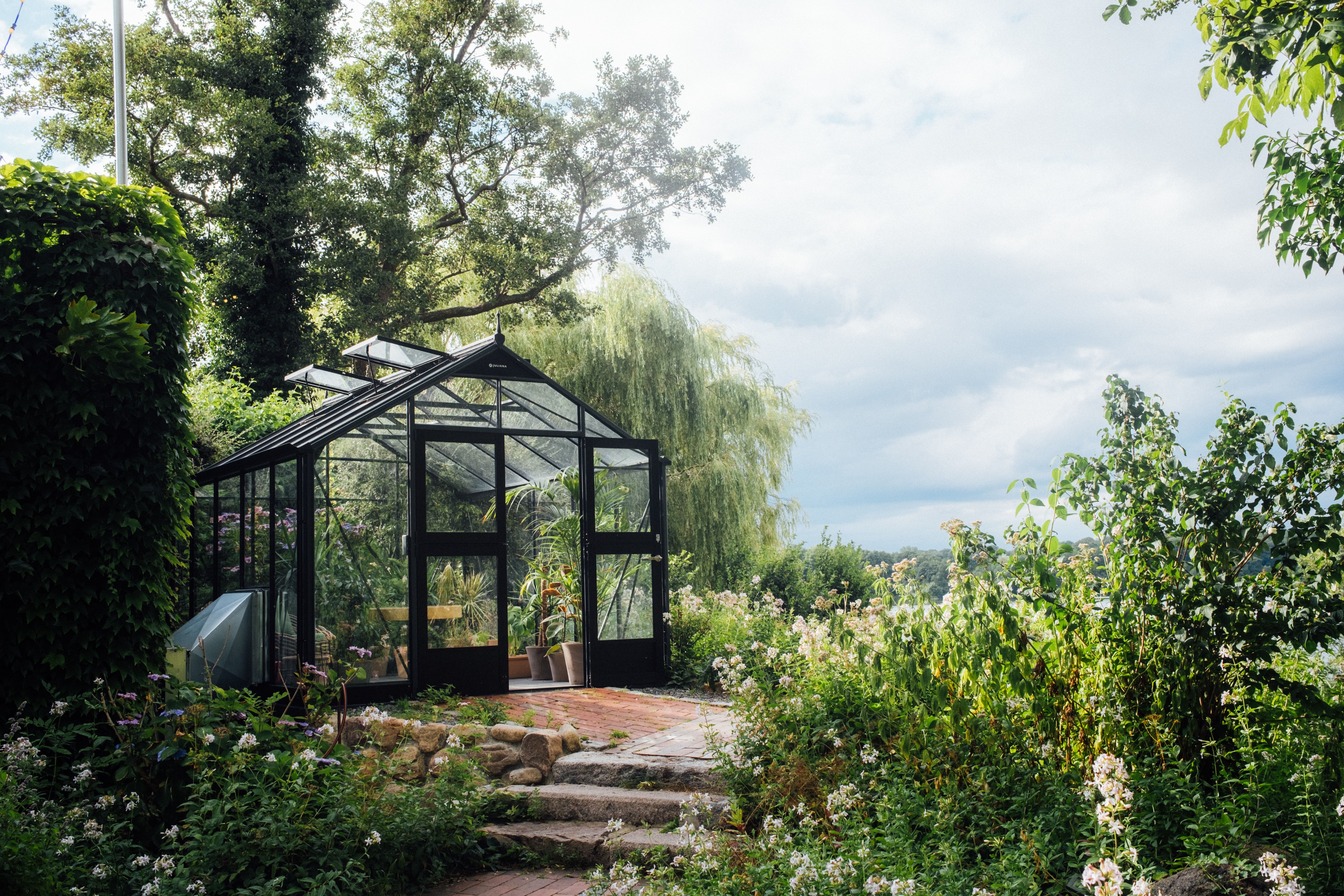
A Riverstone Monticello, sold today under the brand name MONT, runs $3,150 to just under $12,000 depending on size and package tier, with the bulk of buyers landing between $4,000 and $8,000 for a mid-size Premium kit. It is a US-made, extruded-aluminum, twin-wall polycarbonate greenhouse, the domestic answer to imported kits like the Exaco Riga. The honest catch: it is rated for less wind and snow than the Riga, and owners consistently report weaker overnight heat retention, so it earns its keep in temperate and moderately cold climates rather than deep snow country.
That $3,150-to-$11,799 range is worth sitting with for a second, because it directly corrects an assumption that circulated earlier this year. Some retail listings and secondhand summaries put top-tier Monticello packages north of $20,000. Every current dealer page we pulled in July 2026, Home Depot, Greenhouse Nation, MyBBQDirect, Green Living Supply, Greenhouse Gurus, and Greenhouse Emporium, tops out closer to $11,799 for the largest Growers Edition kit. We could not locate a live primary listing anywhere near $20,000 for the standard MONT lineup. Treat that higher figure as unverified until a specific model turns up to support it.
The name change nobody announced clearly
If you’ve shopped this greenhouse across a few sites, you’ve probably noticed it goes by two names. Riverstone Industries built its reputation on the Monticello brand, and that name still appears on Home Depot, Amazon, and Tractor Supply listings, on the model numbers (MONT-8-BK, MONT-16-BK-PREMIUM), and on the boxes some dealers still ship. Riverstone’s own direct storefronts have since folded the product line under the shorter “MONT” brand. It’s the same greenhouse. If you see “Monticello” on one page and “MONT” on another and the model number matches, you’re looking at the same kit, not a redesign.
Riverstone Industries Corporation is a privately held company headquartered in Dover, New Jersey, founded in 2010, with warehousing in Georgia. The company states that over 90% of its products are manufactured in the United States, a specific number worth noting because “Made in the USA” gets thrown around loosely in this category. Riverstone’s own marketing claims its frames use roughly 40 pounds more aluminum than the average imported greenhouse of comparable size, a material-mass argument rather than a design argument, and one worth keeping in mind when you get to the Riga comparison below.

How much does a Riverstone Monticello cost, by tier and size?
Four package tiers, each stacking features onto the same aluminum-and-polycarbonate shell. Prices below are pulled from current dealer pages in July 2026; the same SKU commonly varies $500 to $1,000 between authorized resellers, so treat these as representative rather than fixed.
| Tier | What you get | Smallest size (8x8) | Largest verified size (8x24) |
|---|---|---|---|
| Standard | Automatic roof vents, hinged double doors, rain gutters | $3,149.99 | $6,982.50 |
| Premium | + folding workbench, potting sink, interior shade system | $3,899.99 | $7,199.99 |
| Mojave | + tinted panels, solar-powered thermostatic ventilation, privacy wall | $6,799.99 | not commonly stocked past 8x16 |
| Growers Edition | + 17,000 BTU commercial heater, drip irrigation with programmable timer, electric ventilation, 15-year warranty | $6,399.99 | $9,999.99 to $11,799.00 |
Every tier ships in the same five widths, 8x8, 8x12, 8x16, 8x20, and 8x24, and every size beyond 8x8 is built by bolting 4-foot extension modules onto the base frame rather than shipping a purpose-cast larger unit. That matters for buyers: a 4-foot Premium extension kit runs a few hundred dollars less than the delta between two pre-configured sizes, so if your footprint needs are likely to grow, buying the smaller kit plus an extension later can beat buying big up front. It also means the peak height (7’6”) and sidewall height (4’10”) stay identical no matter which width you choose. You’re buying floor area, not headroom.
Which tier makes sense depends entirely on what you’re trying to avoid buying separately. If you already own a space heater, a potting bench, and a hose timer, the Standard kit at $3,149.99 to roughly $7,000 saves real money. If you’re starting from zero and want the greenhouse to arrive as a finished system, the Growers Edition earns its premium: a 17,000 BTU heater and a programmable drip system bought separately would run close to the price difference anyway, and you’d still need to wire and plumb them yourself.
What owners say once the crate shows up
Home Depot’s owner-review pages across the 8x8, 8x16, and 8x24 Monticello listings return a consistent split, and it’s worth reading both sides rather than the highlight reel.
The build quality reads as genuinely solid. Reviewers across multiple size listings describe the aluminum as durable and the black finish as sharp, with more than one buyer framing it as a case of getting what you pay for compared to cheaper imported kits. Riverstone’s customer service also draws repeat praise, with owners noting replacement parts and support requests handled quickly when something arrives damaged or missing.
Assembly takes longer than the box implies. Riverstone’s own materials describe a patented Twist & Lock single-bolt attachment system meant to cut down on loose hardware, and newer buyers using that system report it as a meaningful improvement. Older listings and reviews of earlier hardware generations tell a rougher story: multiple reviewers describe a two-person, two-full-day build for an 8x8, longer than the “weekend project” framing on the box suggests. Budget the full weekend regardless of which hardware generation you receive, and have two people on hand.
Overnight heat retention is the recurring complaint, and it’s the one that matters most for a review site about season extension. Several Home Depot reviewers report that once the sun goes down, the interior temperature drops close to the outside air temperature, faster than they expected from a “greenhouse.” Some reviewers were specifically critical of the printed assembly instructions and illustrations on certain kits, a complaint Riverstone has partly addressed with the newer Twist & Lock hardware and expanded video guidance, though it isn’t uniform across every SKU and dealer batch.
That heat-retention pattern isn’t a manufacturing defect. It’s physics. Every Monticello tier ships with the same single-spec 8mm twin-wall polycarbonate, there’s no 16mm triple-wall step-up option the way there is on the Riga XL, so the glazing’s insulating ceiling is fixed regardless of how much you spend on the package tier. A Growers Edition owner with the 17,000 BTU heater running is solving that problem with wattage. A Standard-tier owner in a cold snap is not.

Is the Monticello worth it over the Riga?
Depends entirely on your climate, and the two greenhouses were built for genuinely different jobs. A comparison from Mulberry Greenhouses, a dealer that carries both lines, frames the split cleanly: the Riga is built for harsh, frigid winters, and the MONT for temperate, warmer regions. That framing lines up with the manufacturer specs on both sides.
Wind and snow load are the clearest numbers. Riverstone rates the Monticello for 65 mph wind and 24 pounds per square foot of snow load. Exaco rates the Riga at 120-plus mph wind and 20 to 30 pounds per square foot depending on model. That’s not a small gap. If your winters bring sustained heavy snow loads or wind events, the Riga’s engineering has more headroom built in.
Aluminum philosophy differs too, and it’s a genuine design disagreement rather than one side being simply better. Riverstone’s approach is more material: thicker gauge, more total weight of US-grade aluminum in the frame. Exaco’s approach is more structural: the Riga’s profiles are described as having a larger diameter with more internal channels, and the frame sections slide together rather than relying purely on nuts and bolts, a joinery method Exaco markets as more resistant to loosening under repeated wind load. Both are legitimate engineering bets. Riverstone is betting on mass; Exaco is betting on joint geometry.
Where the Monticello wins decisively is price and origin. At every comparable size, MONT pricing runs meaningfully below Riga pricing, the smallest Riga starts north of $5,000 where the smallest Monticello starts under $3,200, and the Monticello never leaves the country to reach your driveway. A warranty claim, a replacement panel, a customer service call, all of it routes through a Georgia-and-New-Jersey company rather than a German-engineered import with an Austrian distributor. If you want a serious aluminum-and-polycarbonate structure without paying the full Riga premium, and your winters are moderate, the Monticello is the more sensible buy. Read the full breakdown in Monticello vs Riga, or see the Riga’s complete spec sheet in our Exaco Riga review.
What size Monticello should I buy?
Start with what you’re actually growing, not what fits the yard. An 8x8 covers a serious hobby grower, roughly a dozen raised trays plus walking room, and it’s the cheapest entry point into every tier. An 8x16 to 8x20 is the sweet spot for someone feeding a household year-round: enough room for a propagation bench, in-ground beds, and overwintering potted citrus or figs without everything crowding the aisle. The 8x24 Growers Edition is a different animal entirely, built for someone selling at a farmers market or running a CSA, where the 17,000 BTU heater and programmable drip system are load-bearing infrastructure, not conveniences.
Whatever size you land on, the foundation decision matters more than the size decision. A Monticello that isn’t set on a level, square base will fight you through every step of assembly, doors that won’t swing true, panels that won’t seat, vents that bind. Our greenhouse foundation guide walks through base options by kit type, and it’s worth reading before the crate arrives, not after.
Accessories worth buying alongside it
Because every Monticello tier ships with the same 8mm glazing regardless of price, the accessories that matter most are the ones that compensate for the heat-retention gap owners consistently flag.
- Bio Green Palma greenhouse heater: a compact 1,500-watt heater with a built-in digital thermostat, sized right for an 8x8 or 8x12 Standard or Premium kit that didn’t come with the Growers Edition’s commercial unit.
- Inkbird ITC-308 temperature controller: wire any heater through this so it only fires when the greenhouse actually needs it, which matters more here than on a heavier-insulated kit since the Monticello’s single-wall-spec glazing bleeds heat faster.
- AcuRite indoor/outdoor digital thermometer: given how often the overnight-temperature-drop complaint shows up in owner reviews, knowing your actual low before you trust seedlings to it is not optional.
- Riverstone Monticello Premium 4’ extension kit: the cheaper path to more floor space if you’re not sure yet whether you’ll outgrow the base size.
As an Amazon Associate, Defy Frost earns from qualifying purchases.

Buy something else if…
The Monticello isn’t the right kit for everyone shopping in this price range.
If you’re in real snow country, zone 5 and colder with sustained heavy snow loads, the 65 mph wind and 24 lb/sq ft snow ratings are a real ceiling, not a marketing footnote. The Exaco Riga is rated meaningfully higher on both counts and offers a 16mm triple-wall step-up on its XL line that the Monticello simply doesn’t have. See our full 4-season greenhouse roundup for how the premium kits stack up for serious winter growing.
If you want maximum growing space per dollar rather than a permanent structure, a Bootstrap Farmer high tunnel gives you far more square footage for the same money, at the cost of a film cover you’ll replace every few years instead of a 10-to-15-year aluminum-and-polycarbonate warranty.
But if you’re gardening through a moderate winter, want a domestically manufactured structure with a domestic support line, and don’t want to pay Riga-level prices to get there, the Monticello earns its place. Buy the Premium tier if you already own a heater and a workbench, buy the Growers Edition if you don’t and want the whole system to arrive in one crate, and get the foundation level before anything else.